
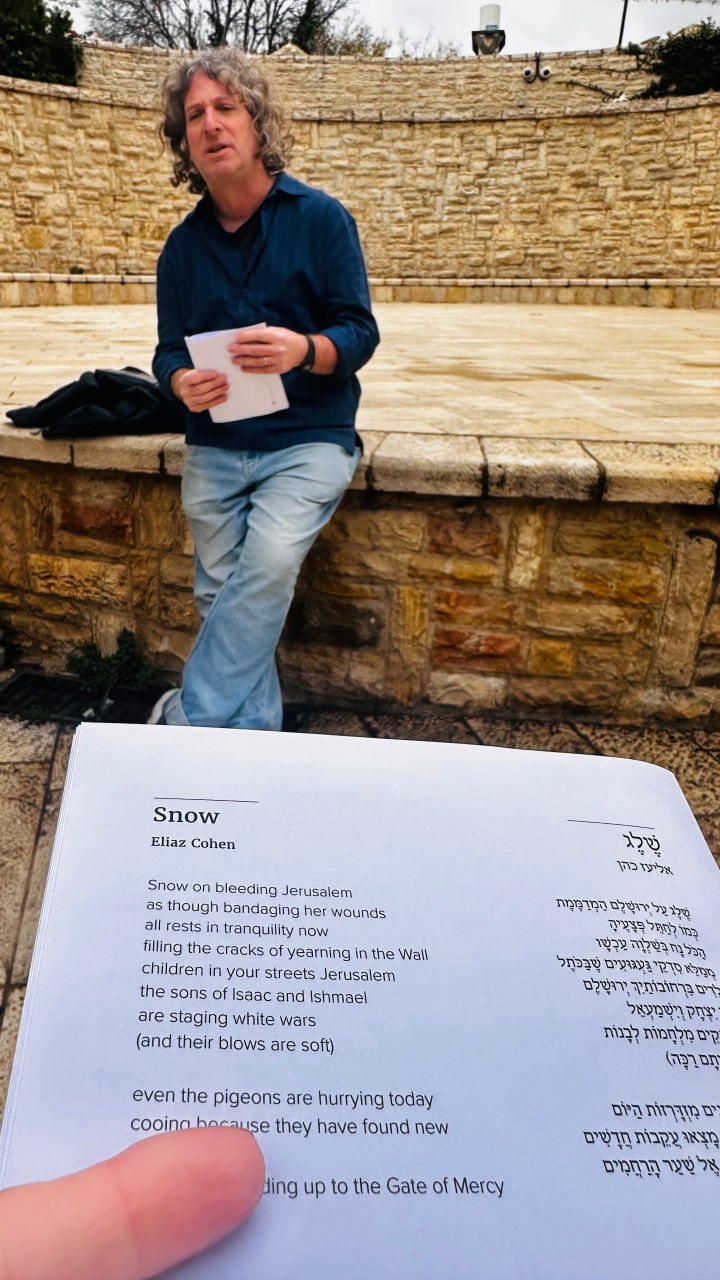
2. Reading the Country Through Poetry
“From the place where we are right
flowers will never grow in the spring.”
— Yehuda Amichai
One unexpected companion on our fellowship journey through Israel was poetry.
This part of the program was facilitated by the iCenter, and throughout the trip, we were introduced to modern Israeli poetry translated into English. At first, it felt like a curious addition to a very practical itinerary. We were traveling to see projects supported by Boston’s Jewish Federation (CJP), meeting educators, community leaders, and young people trying to build bridges between Jewish and Muslim communities.
Poetry seemed like something from another world. But as the trip unfolded, those short lines began to follow us in quiet ways.
One of the first poems we encountered was by Yehuda Amichai, one of Israel’s most beloved poets. The line that stayed with me was this:
“From the place where we are right
Flowers will never grow in the spring.”
It’s a simple but unsettling thought. Amichai suggests that absolute certainty—being completely convinced that we are right—hardens the ground beneath us. When the ground becomes too hard, nothing new can grow. At the time we first read it, the idea felt philosophical. But as the days went on, it began to feel much more practical.
When we sat in Haifa listening to young Arab Israelis describe the tension of living inside a Jewish-majority society, the poem echoed quietly in the background. Their experiences were thoughtful and honest, and they spoke openly about moments when, no matter how integrated they tried to be, they still felt seen as outsiders.
It reminded me of another line we encountered during the trip, by the Israeli poet Dahlia Ravikovitch:
“Every person carries a world.”
That line feels almost obvious when you read it. Of course, every person carries their own experiences, memories, and interpretations of reality. But hearing people describe their lives face to face makes that truth much harder to ignore.
Later in the trip, standing at the site of the Nova music festival, those same lines returned in a different way. The grief and trauma we encountered there are difficult to describe. Many of the stories we heard are meant to be spoken, not written. In moments like that, poetry doesn’t explain anything. But sometimes it provides a language for the emotional weight of a place.
One of the poets I encountered during this trip was Leah Goldberg, who once wrote:
“There are days without forgiveness
and nights without mercy.”
Standing at Nova, those lines felt less like poetry and more like observation. And yet the country itself refuses to remain inside a single emotional frame.
A few days later, walking through Jerusalem during the first evening of Ramadan, I remembered another line by Amichai:
“Jerusalem is a port city on the shore of eternity.”
It’s a strange image. Jerusalem is nowhere near the sea, and yet the metaphor feels right. The city seems to function like a port where centuries of history, religion, memory, and identity arrive and depart all at once. In a place like that, contradictions are not unusual—they are the normal condition of life.
Looking back, I began to understand what the organizers were trying to do by weaving poetry through the fellowship experience. Poetry doesn’t resolve contradictions. It allows them to coexist. A poem can hold grief and hope in the same stanza. It can allow opposing experiences to stand side by side without forcing them into a single narrative. In that sense, poetry may be one of the few languages capable of reflecting Israel honestly.
Because Israel, like poetry, rarely offers simple answers. Instead, it gives you fragments, images, and unfinished lines—and invites you to think about how they might fit together.