
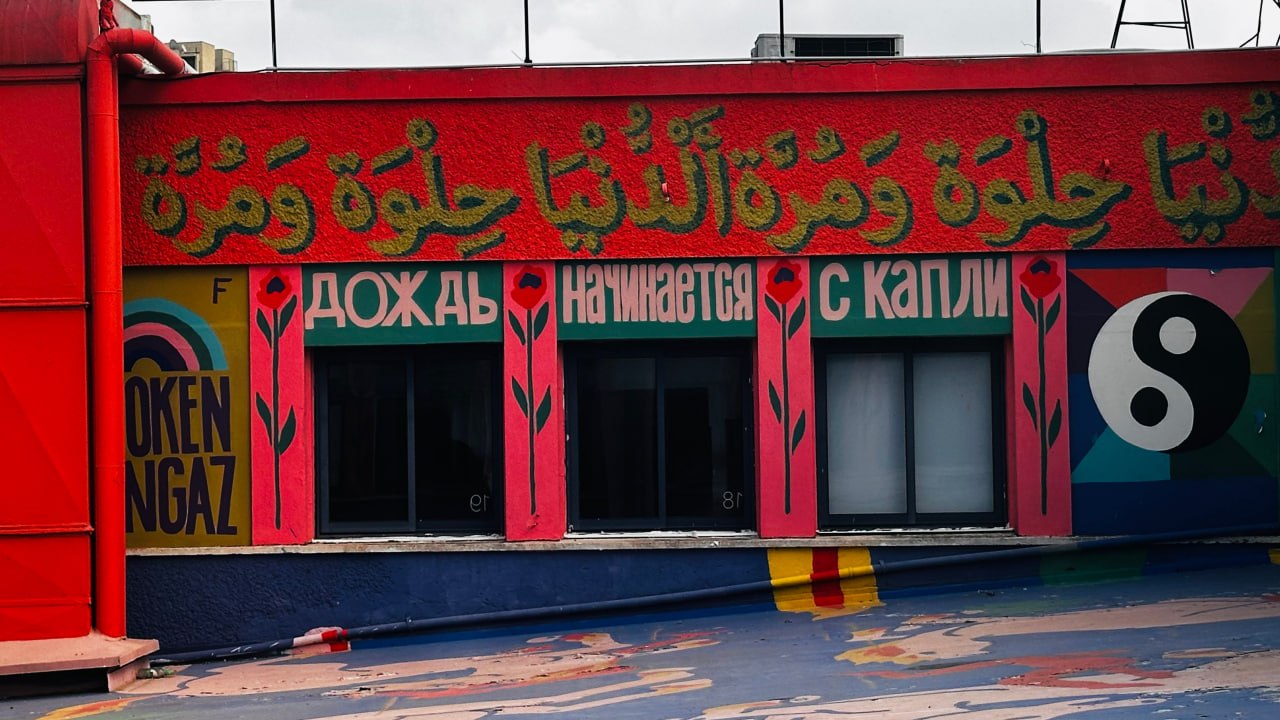
1. Listening in Haifa
“Some stories ask to be heard.
Others ask who is listening.”
I spent four intense days in Israel as part of the Groundwork Fellowship organized through Boston’s Jewish Federation (CJP). The purpose of the trip was simple on paper: to see the projects CJP supports in Israel and understand how those initiatives try to build bridges between Jewish and Muslim communities.
The program itself was facilitated by the iCenter, and they added an interesting layer to the experience. Throughout the trip, we were immersed in modern Israeli poetry—translated into English—using it almost like a lens through which to view the country. It was a surprisingly powerful way to frame what we were seeing. Poetry has a way of capturing emotions that statistics and policy discussions simply can’t.
Most of the projects we visited were in Haifa, which makes sense since Haifa is Boston’s sister city. If you’ve ever been to Haifa, you know it has a reputation for being one of the places in Israel where Jews and Arabs live relatively side by side. It’s often described as a kind of quiet model of coexistence.
Over those four days, we visited a school, a Muslim–Jewish cultural center, and even a children’s soccer program that brings kids from different communities onto the same team. We also spent an evening with CJP’s staff in Israel, enjoying a warm dinner in Haifa and hearing directly from the people on the ground who work with these programs every day.
On paper, all of these initiatives make perfect sense. Education, culture, sports—these are universal languages. If people can meet as students, artists, or teammates before they meet as “Jews” and “Muslims,” maybe something shifts.
But the conversations we had were far more complicated than the program descriptions.
At the cultural center, two young Muslim adults spoke openly about their experiences growing up in Israel. They talked about the tension of trying to remain faithful to their identity while living inside a Jewish-majority society. They described moments when they felt excluded, moments when, no matter how integrated they were, they were still seen as outsiders.
It was honest. And uncomfortable.
What made it even more interesting was that one of our facilitators—someone who grew up in Israel with both Jewish and Arab friends—said that hearing this perspective surprised him. His own experience had always been that coexistence was normal. For him, Haifa had always been a place where everyone simply lived together.
Two men describing the same society. Two very different realities. And that may have been the first lesson of the trip.
But then again, Israel is a place where even Jews don’t always feel equal with each other.
In everyday Hebrew language, there are distinctions everyone knows: sabras (native-born Israelis), vatikim (long-time residents), and olim hadashim (new immigrants). Those labels are often spoken casually, sometimes jokingly—but they can also signal who belongs more comfortably and who is still trying to find their place.
You don’t have to be Arab to feel that. So maybe the story is not simply about Jews and Arabs. Maybe it’s about belonging. And maybe that question—who truly belongs and who still feels like a guest—is one of the threads that runs quietly through Israeli society.
That was just the beginning of the trip.
The next day, we visited the site of the Nova music festival, where the October 7 attack took place. Standing there changed the tone of everything. The conversations we had afterward were no longer theoretical. Many of the people we met there had stories that are almost impossible to write down. Some stories are meant to be spoken, not printed. Yet what struck me most was this: even people who had suffered directly kept repeating the same idea.
Israel still needs to build bridges.
And somehow, the conversation kept returning to the same difficult question: How do you build trust in a place where history keeps interrupting it?