Put Your Family Back Into History
Your Family. Your History. Your Research.
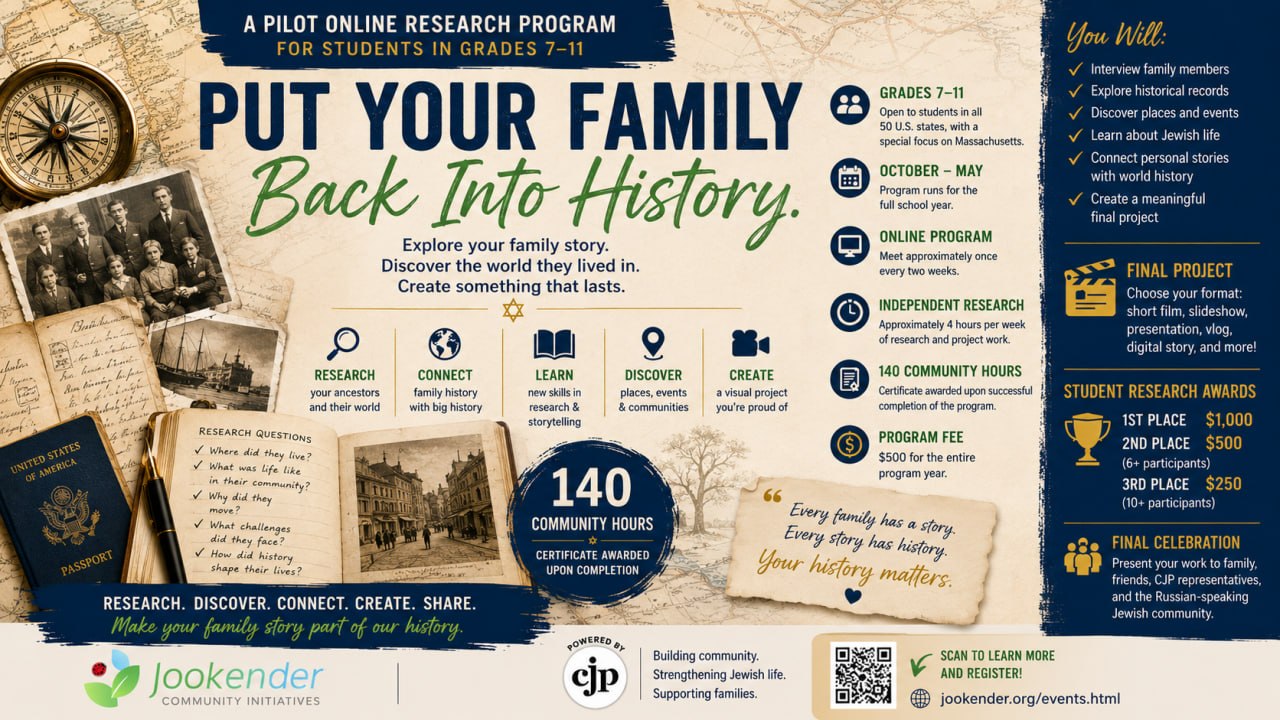
A Pilot Online Research Program for Students in Grades 7–11
What was happening in the world when your great-grandparents were your age? Where did they live? What language did they speak? What was happening in the Jewish community around them? Were they affected by migration, war, pogroms, antisemitism, revolution, changing borders, economic hardship, or political events? Did they choose to move—or were they forced to leave?
And how much of their story can you still uncover today?
Jookender Community Initiatives is launching a new online research program for students in Grades 7–11 who are ready to explore history through something very personal: their own family story.
This is not a traditional genealogy project, and the goal is not simply to build a family tree. Many students have already done something like that in elementary school.
Instead, students will use their family tree as a starting point for a much deeper historical investigation.
Some students may only be able to trace their families to their grandparents or great-grandparents. Others may discover records going back six or seven generations. Some families have preserved photographs, documents, letters, names, and stories. Others may know very little. A parent may have taken a DNA test and discovered previously unknown relatives. A grandparent may remember a village that no longer exists under the same name. Another family may have lost generations of information because of war, migration, the Holocaust, pogroms, or displacement.
Every family will begin from a different place.
That is part of the research.
What Will Students Research?
At the beginning of the program, each student will develop an individual research plan with Jookender.
Students will begin with what they already know and gradually investigate further. Depending on their family history, their research may include:
- interviewing parents, grandparents, great-grandparents, and other relatives;
- collecting family photographs, letters, documents, certificates, immigration records, and oral histories;
- identifying cities, villages, countries, and regions where family members lived;
- researching Jewish life in those places and historical periods;
- examining regional, national, and world events that affected their ancestors;
- exploring migration and immigration patterns;
- investigating changes in borders, governments, languages, and place names;
- studying events such as pogroms, wars, revolutions, the Holocaust, Soviet history, immigration to America, or other events relevant to the individual family;
- using archives, historical databases, libraries, online resources, family records, and, when available, DNA-related family discoveries;
- comparing family memories with documented historical sources.
The central question is not simply:
“Who were my ancestors?”
It is:
“What was happening around them, and how did history shape their lives—and eventually
mine?”
Independent Research with Ongoing Mentorship
This is an independent research program, but students will not be working alone.
We will begin by developing an individual research strategy: what the student already knows, what they want to discover, whom they can interview, which geographic areas and historical periods may become important, and what sources they might use.
After that, students and the program mentor will meet approximately once every two weeks from October through May to discuss discoveries, questions, unexpected findings, research challenges, and next steps.
Whenever possible, meetings will take place as a group so students can learn from one another. One student's discovery may suggest a research method another student never considered.
However, we understand how complicated middle and high school schedules can be. If we cannot find a meeting time that works for everyone, meetings may be arranged individually around students' schedules.
There Is No “Correct” Family History
Students will not be judged by how many generations they can uncover.
One student may trace seven generations. Another may reach a dead end after a great-grandparent.
A missing record can itself tell a story.
Perhaps documents were destroyed. Perhaps borders changed. Perhaps a child grew up in an orphanage after parents were killed in a pogrom. Perhaps a family changed its surname after immigration. Perhaps relatives stopped talking about painful events. Perhaps records exist in another language or under the name of a country that no longer exists.
Historical research often begins with information—but sometimes it begins with its absence.
Students will learn to ask why.
Final Research Project
By the end of the program, every student will transform their research into a visual final project.
Students may choose the format that best fits their interests and skills. Projects might include a short documentary film, video essay, presentation, digital slideshow, vlog, multimedia story, interactive timeline, or another approved visual format.
The final project should do more than introduce relatives or display a family tree. It should demonstrate the connection between family history and larger historical events, places, Jewish communities, migration, culture, and time.
An independent jury composed of members of the Jookender Committee will review the completed projects.
Student Research Awards
First Place — $1,000
If the program has 6 or more participating students:
Second Place — $500
If the program has more than 10 participating students:
Third Place — $250
Awards will recognize the quality of the research and final presentation—not how famous, unusual, dramatic, or well-documented a student's family history happens to be.
Final Community Presentation
The program will conclude with a special gathering where every student will have an opportunity to present their work.
Students' family members will be invited, along with representatives of CJP and members of the broader Russian-speaking Jewish community.
The final gathering will turn individual research into something larger: an opportunity for several generations to come together, listen, remember, ask questions, and see how many different family journeys eventually became part of today's community.
140 Community Hours
Every student who successfully completes the full program and final project will receive a Jookender certificate documenting 140 community hours, based on approximately four hours of research and program work per week.
These hours recognize the student's sustained historical research, documentation, family and community interviews, preparation, participation, and final educational project.
Students and families should check with their individual school or future college regarding how outside/community hours are recorded or considered, since requirements and policies vary by institution.
Program Details
Grades: 7–11
Program Dates: October–May
Format: Online
Meetings: Approximately once every two weeks
Independent Work: Approximately 4 hours per week
Program Fee: $500 for the entire program year
Geography: Open to students in all 50 U.S. states, with a special focus on Massachusetts
Final Requirement: Completed research and a visual final project
Certificate: 140 documented community hours upon successful completion
Questions & Answers
Do I have to be good at history?
No. This is a program for students who are willing to investigate, ask questions, and follow clues. You will learn more history as your research develops.
Do I need to know my family tree before joining?
Absolutely not. You can begin with whatever your family currently knows—even if that is only your parents and grandparents.
What if my family knows almost nothing about previous generations?
Then that becomes part of your research. You may investigate records, historical circumstances, migration patterns, archives, geographic history, or
reasons why family information disappeared.
What if another student can trace seven generations and I can only
trace three?
It does not matter. This is not a competition to see who has the largest family tree. The quality of your research, historical thinking, use of sources,
and final presentation are much more important.
Is this a genealogy class?
Not exactly. Genealogy provides the framework, but the main focus is historical research. Students connect the lives of their ancestors with Jewish,
regional, American, and world history.
Does my family have to be Russian-speaking?
No. The program is open to students from all backgrounds. Jookender has particularly deep experience with Russian-speaking Jewish families and the
histories of migration from the former Soviet Union and Eastern Europe, but family histories from other regions are equally welcome.
Does my family have to be Jewish?
The program includes a meaningful Jewish-history and Jewish-identity component, but students may have diverse family backgrounds, including interfaith and
multicultural families. The individual research path will depend on each student's family story.
What if I discover something difficult or upsetting?
Family research can uncover complicated histories, including war, persecution, pogroms, the Holocaust, separation, adoption, displacement, or family
secrets. Students will never be required to publicly present private information they or their families do not wish to share.
Do I have to take a DNA test?
No. DNA testing is not required. If a family already has relevant DNA results and chooses to use that information, it may become one of many possible
research sources.
Will Jookender purchase access to genealogy databases or
archives?
The $500 program fee covers participation, mentorship, meetings, research guidance, final project review, and the concluding program. Students may use
free resources and resources already available to their families. Any optional paid genealogy services or records should be discussed separately and are not automatically included.
How often will we meet?
Approximately once every two weeks from October through May.
Are meetings group or individual?
We will try to create group meetings whenever schedules allow because students can learn a great deal from one another's research. If a common meeting
time is impossible, individual meetings may be arranged around the student's school schedule.
How much work should I expect?
Approximately four hours per week, including independent research, interviews, reading, historical investigation, documentation, meetings, and
development of the final project.
What does the final project look like?
Students choose a visual format. It could be a short film, documentary, vlog, slideshow, presentation, digital story, multimedia timeline, or another
approved format.
Do I have to be good at video editing or graphic design?
No. Production quality is not the main goal. Strong research and thoughtful storytelling matter much more than expensive software or professional-looking
effects.
How will projects be judged?
Projects will be evaluated by an independent Jookender Committee. Evaluation will focus on the student's research process, historical context, use of
sources, depth of investigation, ability to connect family experiences with larger historical events, and effectiveness of the final presentation.
What are the prizes?
First Place receives $1,000. If at least six students participate, Second Place receives $500. If more than ten students participate, a Third Place prize
of $250 will also be awarded.
Does everyone receive community hours even if they don't win?
Yes. Awards and program completion are separate. Every student who fulfills the program requirements and completes the final project will receive a
certificate documenting 140 community hours.
Can students from outside Massachusetts participate?
Yes. Because the program is online, students from all 50 states may participate. We expect a particular focus on Massachusetts students and families, but
geographic distance should not prevent participation.
Can parents and grandparents participate?
They can become extremely important sources! Students themselves must conduct the research and create the final project, but interviewing relatives and
involving several generations is strongly encouraged.
What happens at the end of the program?
Students will present their projects at a concluding community gathering. Their families will be invited, together with representatives of CJP and
members of the broader Russian-speaking Jewish community. The gathering will celebrate not only the strongest projects, but the research, discoveries, and family histories uncovered by the
entire group.
What if I start researching one story and discover something
completely different?
Excellent. That is what real research sometimes looks like.
You are not expected to know where your story will lead before you begin.
You just need to be willing to follow it.
You are not expected to know where your story will lead before you begin.
You just need to be willing to follow it.