
REEU Paid Internship "STEM in Agriculture"
- REEU - Research and Extension Experiences for Undergraduates
- UMES - University of Maryland Eastern Shore
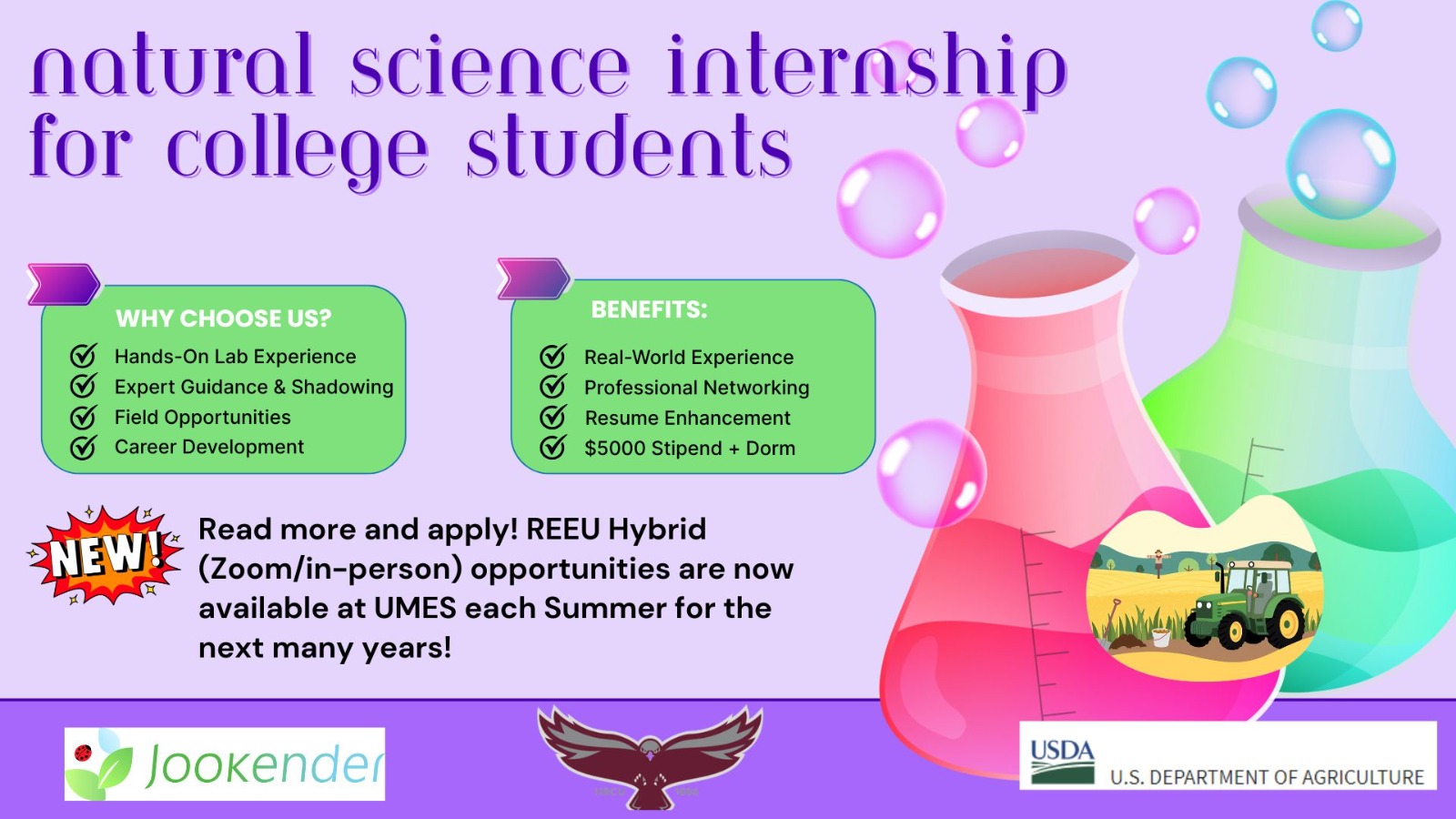
REEU 2026–2031 Internship is a competitive hybrid research program in natural sciences and agriculture. Students complete a year of Zoom-based learning followed by a 10-week summer internship (remote + on-campus at UMES). Includes a $4,000 stipend, $1,000 Food Allowance, and Dorm room (shared for 2 students), and hands-on research. Top students may continue for advanced research and publication.
REEU 2026–2031 Internship Program
STEM research in Agriculture | UMES (University of Maryland Eastern Shore) in partnership with Jookender Community Initiatives, Inc and University of Maryland, College Park.
The REEU (Research and Extension Experiences for Undergraduates) Internship is a highly selective, multi-year program designed for college students pursuing careers in natural sciences, agriculture, environmental systems, and technology.
Over five years, the program will support five cohorts of 6 students each, offering a unique hybrid research experience that combines academic-year learning with hands-on summer research at UMES.
Participants receive:
- $4,000 stipend, $1,000 Food Allowance, and Dorm room (shared for 2 students) is included
- Mentorship from university researchers and industry experts
- Opportunity to contribute to real-world scientific research
Program Structure
Academic Year (Hybrid Learning Phase)
Participants engage in:
- Twice-monthly evening Zoom sessions
- Pre- and post-session assignments
- Guided research preparation and skill-building
Summer Internship (10 Weeks Total)
Phase 1: Remote Research Preparation (3 weeks, June)
- Daily 8-hour Zoom sessions
- Literature review and scientific writing
- Development of research goals, materials, and methods
- Theoretical preparation for lab and field work
Phase 2: On-Campus Research at UMES (6 weeks)
- Full-time, hands-on research experience
- Work on faculty-led projects in areas such as:
- Phytochemistry & Material Science
- Functional Foods (e.g., aronia-based innovations)
- Sustainable agriculture & irrigation systems
- Natural pesticides & environmental safety
- Bio-based extraction technologies
- Field Trips
- Oral Presentation
Phase 3: Finalization & Reporting (1 week, August)
- Remote full-time Zoom sessions
- Data analysis and report writing
- Poster Preparation
- Final project submission
Mentorship & Leadership Opportunities
Participants in early cohorts (2026–2027) will also:
- Opportunity to collaborate and communicate with other programs on campus, including programs for High School.
- Develop leadership and teaching skills
- Collaborate across educational levels
Top-performing students may be invited for:
A second year of research
Co-authorship on a scientific publication
Eligibility Requirements
Applicants must:
- Have a minimum GPA of 3.2
- Be freshmen, sophomores, or juniors at an accredited college or community college (at the time of application)
- Have completed chemistry and general biology
- Be majoring in:
- Chemistry / Biochemistry
- Biology / Environmental Science
- Agriculture / Food Science
- Technology or Computer Science (with AI/programming background)
- Other STEM sciences
- Be U.S. citizens or permanent residents
- Demonstrate strong technical English writing and communication skills
Not eligible:
- Pre-med, pre-pharmacy, or medically oriented majors (veterinary track is allowed)
Commitment Expectations
Participants must commit to:
- Academic-year Zoom sessions (2x per month + assignments)
- Full participation in all summer phases:
- 3 weeks remote (June, full-time)
- 6 weeks on-campus at UMES (end of June-July)
- 1 week remote (August, full-time)
Application Process
Step 1: Preliminary Application
- Submit application via Jookender website
- Complete initial screening form
Step 2: Interview (Jookender)
- Selected applicants will be invited to a Zoom interview
Step 3: Full Application (UMES)
If selected:
- Submit materials to UMES:
- Extended CV
- Unofficial transcripts
- One-page essay: “Why are you interested in STEM in agriculture and how will this internship support your career?”
Step 4: Final Selection
- Double blind evaluation by UMES Team
- Second-round interviews conducted by UMES faculty